Emergency
Broken and Chipped Tooth Care in Canberra City
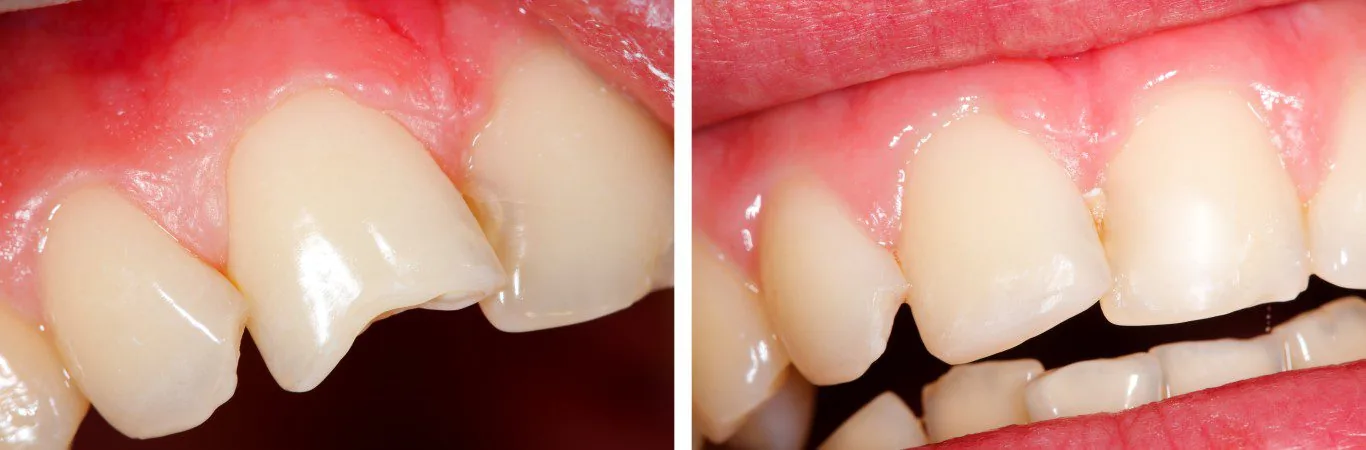
A broken or chipped tooth is worth having looked at even when it does not hurt. Call (02) 6247 9230 and we will book you the earliest time we have. We are open Monday to Thursday, 8:30am to 5pm, and we try to keep room for urgent problems on those days, though we cannot promise an appointment on the day you call.
Healthdirect makes the point plainly: it is best to see a dentist after any dental injury, because you might not be able to see all the damage to your teeth or mouth. A chip that looks cosmetic can run deeper than it appears, and Victoria’s Better Health Channel notes that early repair can improve the survival of a damaged tooth.
First aid for a broken or chipped tooth
- Keep the broken piece if you can find it. Healthdirect advises storing a fragment in milk or sterile saline and bringing it with you. Better Health Channel adds that your own saliva will do, sealed in a container or plastic wrap. Do not let it dry out, and do not scrub it
- Rinse your mouth with warm water to clear any debris and let you feel where the break is
- If there is bleeding, apply gentle pressure with a clean towel or dressing until it stops
- If there is swelling, hold a cold compress against the outside of your cheek — an ice pack wrapped in a cloth, never directly on the skin
- Cover a sharp edge if it is cutting your tongue or cheek. A piece of sugar-free chewing gum or a little orthodontic wax pressed over the edge will get you through until we see you
- Stick to soft food, and keep away from very hot and very cold drinks and from chewing on that side
- For pain relief, ask your pharmacist or doctor. Paracetamol is the usual first option. Healthdirect cautions against high doses of aspirin because aspirin thins the blood and can increase bleeding, and says not to give aspirin to a child under 12 unless a doctor has advised it
- Keep the area clean and keep brushing gently. Healthdirect notes there is a risk of infection after a dental injury
- Call us on (02) 6247 9230, and tell us how the tooth broke and whether it hurts, so we know how quickly you need to be seen
If the whole tooth has come out, the clock matters and the first aid is different — see our page on a knocked-out tooth. In short: hold it by the crown, never the root, and aim to reach a dentist or hospital within 30 minutes.
When a broken tooth is an emergency
Healthdirect advises calling an ambulance on triple zero (000) or going straight to an emergency department if a dental injury comes with:
- Trouble breathing
- Trouble talking or swallowing
- A lot of blood going down your throat
- A very swollen mouth or tongue
Heavy bleeding in the mouth needs urgent medical care, because of the chance the airway could become blocked. A hospital is also the right place for a suspected broken jaw, a deep cut to the lip or face, or an injury from a fall or knock where the person was knocked out or is confused.
Contact us or a doctor if, in the days after an injury, you develop swollen glands in the neck, a fever over 38°C, pus, a bad taste in your mouth, or nausea. Those point to infection setting in.
Cracks you cannot see
Not every damaged tooth has a visible piece missing. A crack can sit inside the tooth or under an old filling and still cause trouble. The Australian Dental Association’s patient guidance lists the usual signs of a cracked tooth as sharp pain on biting that goes away once you stop, pain that does not happen every single time you bite, sensitivity to cold or hot, and a feeling that the teeth are meeting differently.
That intermittent quality is exactly what makes cracks hard to pin down, and why we often need to test individual teeth rather than take your word for which one hurts — the sore tooth is not always the cracked one.
Cracks tend to have a history behind them. The ADA points to clenching and grinding, opening bottles or packaging with your teeth, chewing ice, biting unexpectedly onto something hard like an olive stone, and erosion from acidic food and drink, reflux or vomiting. Older fillings play a part too: amalgam expands and contracts slightly with hot and cold, which puts pressure on the tooth over years, and because amalgam does not bond to the tooth, more tooth had to be cut away to hold it in place.
What we will do
We will ask how the tooth broke and when, then examine the tooth, the teeth either side, your bite and the soft tissue, and take an X-ray where one is needed to see how far the damage goes and whether the nerve or the root is involved. If a crack is suspected, we may remove an existing filling and look underneath, because that is often the only way to see the full extent of it.
If you are in pain or the tooth is sharp, making you comfortable comes first. After that you will get a plain explanation of what we found, the options with their trade-offs, and an estimate of the cost before anything goes ahead.
Treatment options
What is possible depends on how much tooth is left and whether the nerve is affected.
- A small chip in enamel may need nothing more than smoothing, or a tooth-coloured filling bonded to rebuild the shape. The ADA notes that small enamel cracks not running deep often need no treatment at all beyond keeping an eye on them
- A larger break usually needs the tooth rebuilt with a filling or, where a lot of structure is gone, a crown that covers the tooth and holds it together so it does not flex and hurt when you bite
- Where the nerve inside has been injured or has died, healthdirect notes you may need root canal therapy, and after root canal treatment a crown is commonly needed to protect what remains
- A loose or displaced tooth may be stabilised with a splint or bonded to the neighbouring tooth while the mouth heals
- Where a crack runs into the nerve or deep towards the root, treatment may no longer be possible and removing the tooth becomes the sensible option. We will set out how the gap could be filled afterwards
Sometimes the honest answer is that we need to test first. The ADA describes placing a temporary crown or a metal band tightly around a suspected cracked tooth to see whether the symptoms settle; if they do, a crown is likely to work.
What is worth knowing
Not every broken tooth can be saved, and no one can promise how long a repaired tooth will last. The ADA is direct about this: with a cracked tooth, how long it survives may not be predictable, and some cracks get worse over time and end with the tooth needing to come out. A crown reduces that risk. It does not remove it.
Treatment carries its own risks. Expect the tooth to be tender for a few days afterwards. Local anaesthetic causes temporary numbness and occasionally bruising. A tooth that has had root canal therapy can need further work later, and healthdirect notes that when an adult tooth is reimplanted after being knocked out there is a high chance it will need root canal therapy in the future. Rebuilding a tooth also removes some healthy structure, and a very large repair on a tooth with little left may fail and need to be redone.
Repair often happens in stages rather than in one visit. Settling a tooth first and rebuilding it properly once things have calmed down is usually the better sequence, not a delay.
Where grinding or clenching is part of the cause, treating only the broken tooth leaves the cause running. A night guard may be worth discussing, and if you play contact sport, a fitted mouthguard is the single most effective way of avoiding the next one. We can talk about grinding and clenching at the same appointment.
If we are closed
We are closed on Fridays, weekends, public holidays and outside 8:30am to 5pm. You can call healthdirect on 1800 022 222 at any hour to speak to a registered nurse. Canberra Health Services Walk-in Centres are open 7:30am to 10pm every day, but they cannot treat dental injuries, so a broken tooth is not something they can help with. For an injury with heavy bleeding, a suspected broken jaw or difficulty breathing or swallowing, go to an emergency department. Concession card holders may be able to access public emergency dental care through Central Health Intake on (02) 5124 9977. Our emergency dental page sets out all of these options in full.
If you have kept the broken piece, store it in milk or saliva and call us on the next practice morning. Care obtained elsewhere out of hours is usually a holding measure, and the tooth will still need to be properly assessed.